A little more than half a year ago, I started to get into amateur astronomy. There is something very relaxing about being the only only person still up, ideally a bit away from civilization and its light pollution -- just you, a telescope, and the night sky. But as much as I enjoy my solo stargazing sessions, there is something magical about sharing this experience with other people. Half a year is not a long time in this hobby, but you do get used to spectacular views like the cloud bands on Jupiter or the Andromeda galaxy. Watching someone else experience these objects for the first time is incredibly rewarding for me and helps keep the wonder alive.
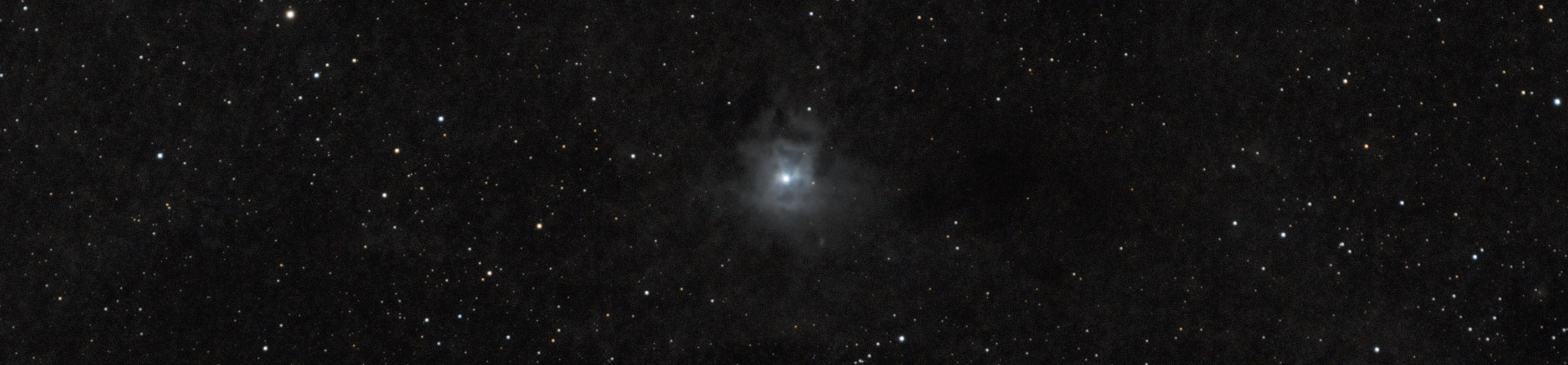
With that said, I have had a number of opportunities to host stargazing sessions and have by now developed a rough routine for stargazing with other people. I'm writing it down here as a reference for myself, but feel free to use it as a guide for your own stargazing sessions or to guide other people. As I host more sessions, I will try to keep this post up to date.
Preparation
My stargazing sessions have ranged from very impromptu, "It's clear outside, let's see what is visible" to carefully planned trips. Ideally, I like to have some preparation time to find a suitable date and location. A good location is one with dark skies, few lights around, and a clear horizon. To check for dark skies, I use Light Pollution Map to get at least a rough idea. However, if the session is more spontaneous, I might not be able to travel to a darker site. In that case, I look for something like a park or meadow.
Picking a date is also not trivial. I like to use Clear Outside to keep track of the weather, particularly how cloudy it will be. I also use Meteoblue's maps to look at cloud movements. These forecasts all have limited precision, so planning more than about three days ahead tends to be difficult. There is also one more consideration for timing observing sessions: the moon. Human-made light pollution washes out the sky and makes objects harder to find, but even at a dark sky site, a full moon will influence your ability to observe just as much. Since the motion of the moon is predictable, you can plan around this. Even if the moon is visible, you can usually still observe brighter objects, but for instance objects near the moon will be invisible. You can also plan sessions before the moon has risen or after it has set if you are outside long enough.
While it is possible to go stargazing just with the naked eye, I usually bring some equipment as well. I often have a pair of 8x42 binoculars just with me in my backpack. These are fairly light and durable, and will already give you a good view of bright objects like the Pleiades, the Orion nebula or the Andromeda galaxy. Their greatest disadvantage is that they are handheld. This means that I can't just orient them towards and object and let people see through them. Instead, I have to give directions like "Start at the bright star in the east and look straight down until you find a pattern like the pips for a five on a six-sided die, but slightly skewed. The object is a slightly fuzzy spot above the upper left pip."1 If I have time to plan ahead and pack, I will bring a proper telescope and mount. I like my 102/600mm refractor on a simple Alt-Az mount for this, as it offers a fairly wide view and easy movement controls even for beginners. I usually bring an 18mm eyepiece for most views and a 9mm eyepiece for zooming in a bit. Additionally, I bring a red flashlight (just a regular flashlight I got from the supermarket and put some red foil in front) and especially in winter, a thermos of hot tea will make observing more pleasant.
I'd also recommend keeping the group size fairly small, about five people seems ideal. Too many people means that everyone gets maybe half a minute at the telescope and then has to wait for everyone else to take their turn. Besides, you'll be outside in the dark -- fewer people means that it's easier to keep an eye one everyone.
Orientation
I like to start by having the attendees identify Polaris, the north star. Polaris is very close to the celestial north pole, and all other objects appear to rotate around it because its position lines up very well with the earth's rotational axis. Finding Polaris is fairly easy because you can just go from the Big Dipper or Cassiopeia, both constellations that even non-astronomers can usually identify. Starting this way helps me in three ways:
- Knowing the cardinal directions helps me identify constellations and find other objects more quickly.2
- It gets the attendees to think about the night sky -- maybe they'll see something interesting on their own!
- I can gauge their level of experience.
The last one is especially important. If I have a large number of attendees with some prior experience, I can maybe show them some of the more difficult to find objects or go into more detail. In a larger group it can also be helpful to get a more experienced attendee to help the other ones and the Polaris exercise helps identify candidates for this.
Planets
Once everyone has found Polaris, I like to move on to planets (if any are visible). Planets stand out because they appear brighter than stars, making them a good first target. I personally like Jupiter because you can see the cloud bands and moons, but Saturn or Venus are also fun to observe. If I only have binoculars, I can only show that Jupiter appears as a circle, unlike the pinprick stars around it and that you can see its moons lined up around it. With a telescope, you can also see the cloud bands. My refractor is only an achromat, so there is some false color, but with the 9mm eyepiece, you still get a great view of Jupiter's cloud bands.
If I have a somewhat technical crowd, I use this opportunity to talk about astronomy gear, particularly types of telescopes and mounts. This is also a good basis if anyone is looking for gear recommendations at the end of the session.
Right now, the only other visible planet is Venus. You don't get any surface detail there, but Venus has phases, similarly to the moon.
Galaxies
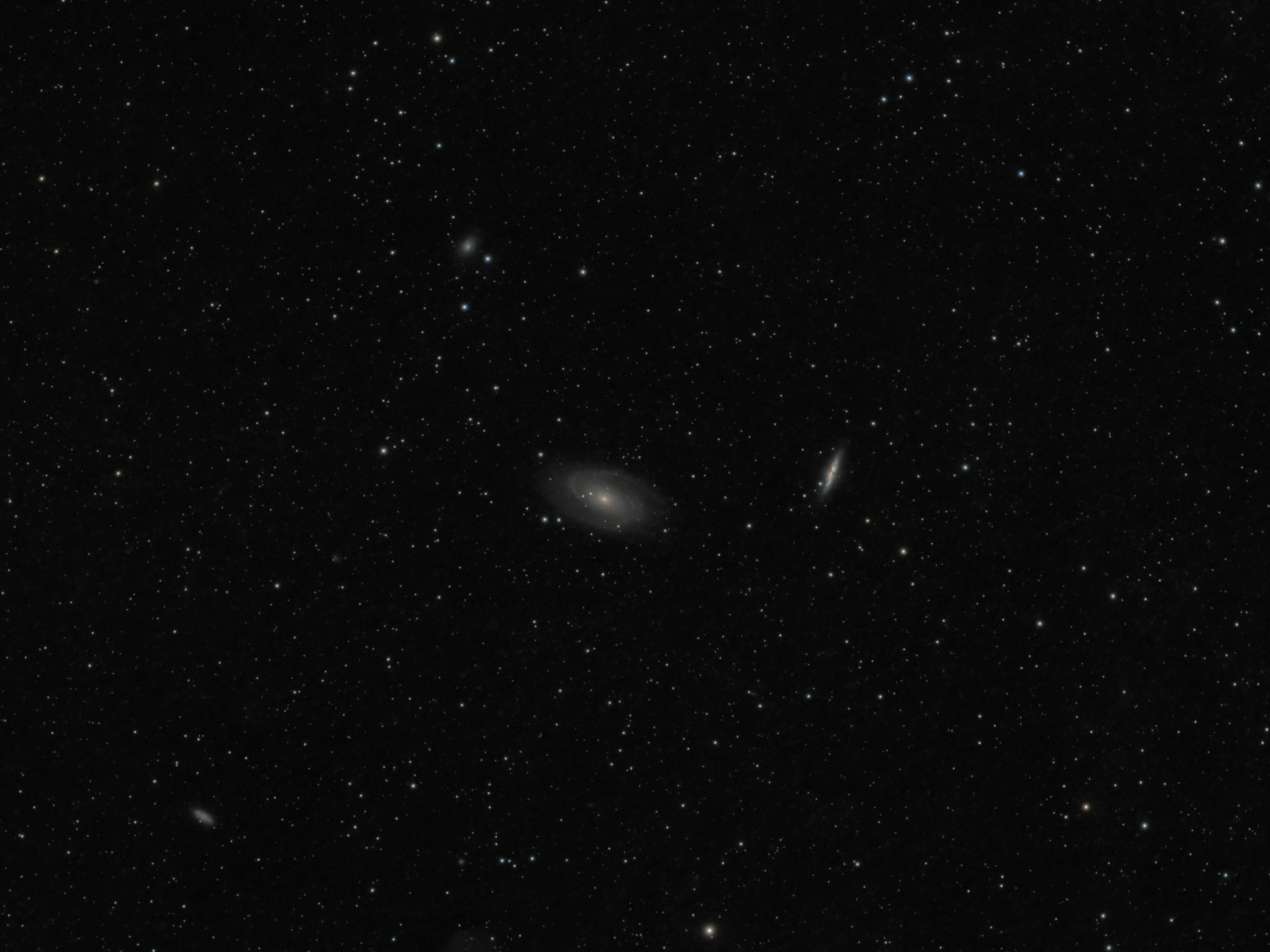
Once everyone has had the chance to see some planets, I like to move on to galaxies. You won't get a lot of detail on them, unless you are at a very dark site and/or have a very large telescope, but most people know what a galaxy is and find just the idea of seeing one live exciting. If it is visible, the Andromeda Galaxy (aka M31) makes for a good target, as it can be seen with the naked eye from a dark enough site. Even just with binoculars, its oval shape is clearly visible. If M31 is not available, there are some other options, though. I like M81 and M82 (Bode's and the Cigar galaxy) in Ursa Major, since you can see them both at the same time at low to medium power. This pair also showcases that galaxies come in different shapes and sizes: While M81 is a classic spiral galaxy, M82 has a long, slender shape from which its nickname "The Cigar Galaxy" derives. The two galaxies are, however, too dim for binoculars in my experience.
Around this time, I also like to introduce Messier numbers. I like to tell the anecdote that 18th century astronomer Charles Messier was interested in comets and only compiled his catalogue to make a note of objects that annoyed him in that pursuit. These days, Messier is of course know for his catalogue, and not as a comet hunter. While people won't remember specific Messier numbers, that anecdote tends to stick.
Star Clusters
Now, we get to the slightly more obscure objects. While almost everyone knows about planets and galaxies, fewer people know about star clusters. I usually start with open clusters as they tend to look more interesting. The poster child of open clusters is of course the Pleiades (M45). You can make out the brightest stars in this cluster with the naked eye, and you can even tell that they are somewhat separate from the stars surrounding them. For the Pleiades, you want to use binoculars or a telescope at low power -- it's easy to zoom in too far and not see their structure as a whole. Right now, the Pleiades are not visible, so instead I turn to M36 to M38 in the constellation Auriga. While these are less immediately spectacular, they have a more uniform brightness which makes it easier to see their fine structure. M44 in the constellation Cancer is also fun to observe, though I find it easier to locate the clusters in Auriga.
At this point, someone may have asked if there are closed clusters. This makes for a good segue to introduce globular clusters. Unlike open clusters which consist of up to a few thousand stars, globular clusters contains tens of thousands to millions of stars. Gravity keeps them in a spherical shape. Through most binoculars and telescopes, you can see them as a fuzzy spot, but at a dark site with good equipment, you may be able to resolve some stars around their edges. One of the easiest to locate clusters is M13 in Hercules, although M3 and M5 (which are located around Arcturus) are also not too bad. As with galaxies, the view itself is not that spectacular, but you are selling the idea that your attendees are looking at millions of stars held together by gravity.
Seasonal Attractions
While the above list works or can be adapted for most times of the year, I try to be aware of seasonal objects and events. For instance, in the winter I like to show people the Orion nebula. Nebulae are not really an option for visual observation because most are too dim or outside the human visual spectrum. The Orion nebula is a spectacular exception to this rule. You might be able to see some planetary nebulae (e.g. the ring nebula, M57, in Lyra), but these require dark skies and high power to appreciate.
There may also be meteor showers (e.g. the Lyrids in spring or Perseids in summer) or comets visible for a limited time. Especially with meteor showers, there is no guarantee that you will see any, but looking for them can be fun for those attendees who are currently not looking through the telescope.
Finally, if the moon is out, it makes for a good closing object. You can, of course, see some detail on the moon with the naked eye, but binoculars or a telescope will bring out a lot more. I especially like observing around the moon's terminator (the dividing line between light and shadow), as the contrast there gives an amazing sense of depth to the lunar landscape. So why save the moon for last? Even through a lunar filter, the moon is incredibly bright and will ruin your night vision. So, it makes sense to place it at the end.
This usually ends the guided part of the session. Depending on the circumstances, I may revisit objects with people or let them look around on their own. Maybe someone got the astronomy bug and is asking for a telescope recommendation to get started. Just as often, everyone is now tired and we just pack up and go home. Either way, a night spent under a clear, starry sky is always a good time.
-
You get a virtual cookie if you can guess which object those directions are for. If you need a hint: It's a globular cluster. ↩
-
Yes, I am aware that mounts with goto functionality exist. In fact, I make heavy use of this feature for my astrophotography. However, any electronical component will break or misbehave at the worst possible moment, especially in cold and damp nights. Besides, I personally just prefer to find objects for visual observation on my own. ↩